Challenges In Doing Education And Communication Related To The Digitalization Of Tax To The Public
Keywords:
Education, Tax Digitalization, Tax Education, Tax CommunicationAbstract
Digitalization in the field of taxation is very important for the government and society to ensure a more efficient and transparent tax collection process. However, the main challenge in conducting education and communication related to digitalization of taxation is increasing public awareness and understanding of the importance of this process. Limited resources, information, and understanding of technology are also obstacles in conducting effective and targeted education and communication. Therefore, there is a need for consistent and integrated efforts to address this challenge and increase public understanding and participation in tax digitization.References
Bakic-Miric, N. (2019). Critical Theory of Communication, New Readings of Lukács, Adorno, Marcuse, Honneth and Habermas in the Age of Internet.
Chandler, D., & Fuchs, C. (2019). Digital objects, digital subjects: Interdisciplinary perspectives on capitalism, labour and politics in the age of big data. University of Westminster Press.
Fuchs, C. (2015). CULTURE AND ECONOMY IN THE AGE OF SOCIAL MEDIA
Mosco, V. (2019). To the Cloud Big Data in a Turbulent World
Blackhawk, M. (2019). Federal Indian law as paradigm within public law. Harvard Law Review, 132(7), 1787-1877.
Davidson, S. (2020). Made by a human like you or me: Back to the Greek classics to further develop the rhetorical paradigm of public relations. Public Relations Review, 46(1), 101888.
Ferguson, M. A. (2018). Building theory in public relations: Interorganizational relationships as a public relations paradigm. Journal of public relations research, 30(4), 164-178.
Kelly, K. S. (2020). Fund raising and public relations: A critical analysis. Routledge.
Kent, M. L., & Li, C. (2020). Toward a normative social media theory for public relations. Public Relations Review, 46(1), 101857.
Torfing, J., Andersen, L. B., Greve, C., & Klausen, K. K. (2020). Public governance paradigms: Competing and co-existing. Edward Elgar Publishing.
Shinde, R. S., & Boinwad, D. L. (2019). Paradigm shift in food habits due to stressful life-a research in pune city. Sumedha Journal of Management, 8(3), 112-124.
Yang, A., & Saffer, A. J. (2019). Embracing a network perspective in the network society: The dawn of a new paradigm in strategic public relations. Public Relations Review, 45(4), 101843.
Casady, C. B., Eriksson, K., Levitt, R. E., & Scott, W. R. (2020). (Re) defining public-private partnerships (PPPs) in the new public governance (NPG) paradigm: an institutional maturity perspective. Public Management Review, 22(2), 161-183.
Gruszczynski, L. (2020). The COVID-19 pandemic and international trade: Temporary turbulence or paradigm shift?. European Journal of Risk Regulation, 11(2), 337-342.
Hammack, P. L., Frost, D. M., & Hughes, S. D. (2019). Queer intimacies: A new paradigm for the study of relationship diversity. The Journal of Sex Research, 56(4-5), 556-592.
Peters, M. A., Jandrić, P., & McLaren, P. (2020). Viral modernity? Epidemics, infodemics, and the ‘bioinformational’paradigm. In Pandemic Education and Viral Politics (pp. 9-40). Routledge.
Kankam, P. K. (2019). The use of paradigms in information research. Library & Information Science Research, 41(2), 85-92.
Meng, J., & Berger, B. K. (2019). The impact of organizational culture and leadership performance on PR professionals’ job satisfaction: Testing the joint mediating effects of engagement and trust. Public Relations Review, 45(1), 64-75.
Leonardi, P. M., & Treem, J. W. (2020). Behavioral visibility: A new paradigm for organization studies in the age of digitization, digitalization, and datafication. Organization Studies, 41(12), 1601-1625.
Gora, R., & S Sos, M. M. (2019). Riset kualitatif public relations. Jakad Media Publishing.
Meijer, A. J., Lips, M., & Chen, K. (2019). Open governance: A new paradigm for understanding urban governance in an information age. Frontiers in Sustainable Cities, 1, 3.
Diana, R. E., & Oktarina, F. (2021). Microhome Design: A New Paradigm of Home Terminology.
Olsen, A. L., Hjorth, F., Harmon, N., & Barfort, S. (2019). Behavioral dishonesty in the public sector. Journal of Public Administration Research and Theory, 29(4), 572-590.
Mialon, M. (2020). An overview of the commercial determinants of health. Globalization and Health, 16, 1-7.
Jolly, A. (2022). The Central Asian Paradigm in Anglo-Russian relations, 1885–1895 (Doctoral dissertation, University of East Anglia).
Semple, T. (2023). Hipsterism: A Paradigm for Modernity (p. 192). Springer Nature.
Nelipa, D. V., Tsvykh, V. F., Zubchyk, A., Sytnyk, G. P., & Hrebonozhko, Y. P. (2020). The New Public Management paradigm as a further interaction of the public and private sectors. Revista San Gregorio, 1(42).
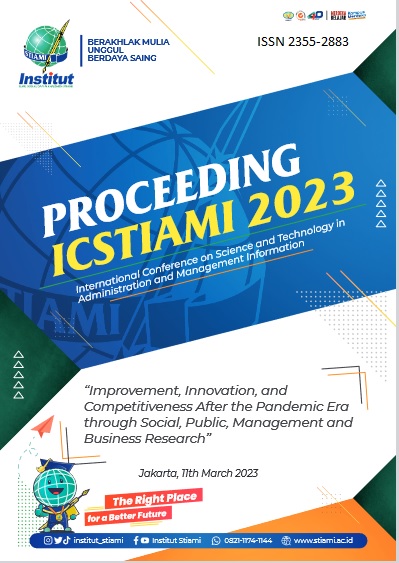
Downloads
Published
Issue
Section
License

This work is licensed under a Creative Commons Attribution-ShareAlike 4.0 International License
Please find the rights and licenses in Prosiding Seminar STIAMI By submitting the article/manuscript of the article, the author(s) agree with this policy. No specific document sign-off is required.
- License
The commercial use of the article will be governed by the Creative Commons Attribution license as currently displayed on Creative Commons Attribution-ShareAlike 4.0 International License.
2. Author(s)' Warranties
The author warrants that the article is original, written by stated author(s), has not been published before, contains no unlawful statements, does not infringe the rights of others, is subject to copyright that is vested exclusively in the author and free of any third party rights, and that any necessary written permissions to quote from other sources have been obtained by the author(s).
3. User Rights
Prosiding Seminar STIAMI spirit is to disseminate articles published are as free as possible. Under the Creative Commons license, Prosiding Seminar STIAMI permits users to copy, distribute, display, and perform the work for non-commercial purposes only. Users will also need to attribute authors and Prosiding Seminar STIAMI on distributing works in the journal and other media of publications.
4. Co-Authorship
If the article was jointly prepared by more than one author, any authors submitting the manuscript warrants that he/she has been authorized by all co-authors to be agreed on this copyright and license notice (agreement) on their behalf, and agrees to inform his/her co-authors of the terms of this policy. Prosiding Seminar STIAMI will not be held liable for anything that may arise due to the author(s) internal dispute. Prosiding Seminar STIAMI will only communicate with the corresponding author.
5. Miscellaneous
Prosiding Seminar STIAMI will publish the article (or have it published) in the journal if the article’s editorial process is successfully completed. Prosiding Seminar STIAMI editors may modify the article to a style of punctuation, spelling, capitalization, referencing and usage that deems appropriate. The author acknowledges that the article may be published so that it will be publicly accessible and such access will be free of charge for the readers as mentioned in point 3.
Every accepted manuscript should be accompanied by "Copyright Transfer Agreement"prior to the article publication.